 View Large
Braces & Aligners
Before we discuss the distinctions between clear aligners and braces, let’s clarify what they are.
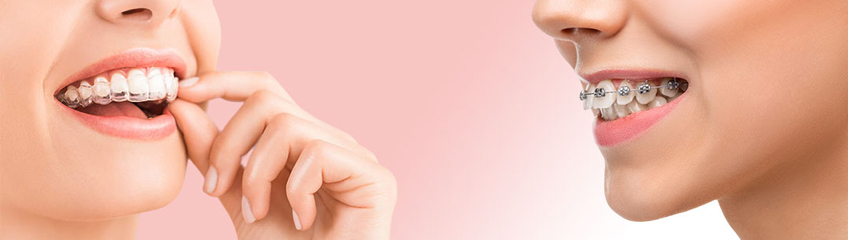
Bracelets. These are tiny metal components, commonly referred to as brackets, that are affixed to the tooth’s surface and connected by a metal arch. In order to gradually move teeth into the proper locations, this arch connects the brackets and applies constant pressure to them. Braces come in a variety of forms, including metal, transparent, lingual, and self-ligating. All braces have one thing in common: they are secured in place.
Clearly marked aligners. Clear or invisible aligners are 3D printed, detachable splints that are placed over the teeth to correct misalignments by continuously applying pressure. They work similarly to braces.
In terms of how effective dental aligners are compared to braces, aligners can address orthodontic problems equally as well. In actuality, it is more important to take into account the strategy each use to get the intended grin objectives. We shall examine the distinctions between metal braces and clear aligners below.
Braces
In a traditional brace, the teeth are bonded to metal brackets and wires that provide movement and connection. They adjust crowded, crooked, or misaligned teeth by applying pressure and gradually shifting the teeth. Your orthodontist adjusts your brackets on a periodic basis in the office. We also provide a clear ceramic option if you choose not to use metal brackets. Clear ceramic braces function in the same way as conventional braces, except instead of using metal, they are made of clear or tooth-colored material.
Clear Aligners
3M and BracesBracesBraces collaborate on Clarity Aligners. Compared to traditional braces, clear aligners are far less apparent. They are clear, plastic-like trays. For the treatment of gaps, overbites, underbites, and crowded teeth, clear aligners can be utilised. You will receive trays from your orthodontist along with care instructions, and you will need to return for routine tray checks.
What’s the difference?
The primary distinction between the two is the short-term removal of the clear aligners for eating, drinking, brushing, and flossing. Since braces are cemented to the teeth, patients are unable to take them out. Furthermore, crooked or misaligned teeth can be straightened with braces or with clear aligners; the optimum treatment depends only on the severity of the issues.
Braces are better suited for people with more severe cases of crooked or misaligned teeth, whereas clear aligners are better for people who do not require substantial tooth movement or rotation. A person can discreetly straighten their teeth with clear aligners because they are almost unnoticeable while worn. Braces are more noticeable to the naked eye, and you can personalise your braces with coloured rubber bands!
Are you eager to begin your smiling adventure, but are unsure which path is ideal for you? Make an appointment for your complimentary consultation right now!